
A retirement can last 25 years or more, and prices rarely stand still that long. Here is how inflation works on a retirement income, which kinds of income keep up, and the common ways retirees protect the rest.
Helen retired at 66 with three sources of income: $2,100 a month from Social Security, a $1,200 monthly pension from her years at a manufacturer, and $300,000 in savings. On paper, $3,300 a month covered her bills with room to spare.
Five years later she noticed something odd. Her Social Security check had grown every January. Her pension check was exactly the same as the day she retired, but it paid for less each year. Nothing had gone wrong. That is simply what inflation does to a fixed income.
Key takeaways
- At 3% inflation, prices roughly double in 24 years, so a fixed income loses about half its buying power over a long retirement.
- Social Security rises with inflation each January; the 2027 increase is 3.6%. Most private pensions and many annuities stay the same.
- In our example, a $1,200 pension with no increases buys what only $664 buys today after 20 years of 3% inflation.
- Common protections include delaying Social Security, inflation-linked bonds, keeping some money invested for growth and flexible spending.
How inflation chips away at a retirement income
Inflation is the general rise in prices over time. The Federal Reserve aims to keep it around 2% a year, but it has run much higher at times, as it did in 2022.
A quick way to see the effect is the Rule of 72: divide 72 by the inflation rate to find how many years it takes prices to double. At 3%, that is 24 years. A $50 grocery bag today would cost about $90 in 20 years.
Retirees feel this more than workers. A paycheck usually rises over a career; many retirement incomes don’t. And the costs that matter most later in life, such as health care, don’t always follow the overall average. The Bureau of Labor Statistics tracks a research index of prices for people 62 and older for that reason, though it isn’t used to set any benefits.
Which income keeps up with inflation?
| Income source | Adjusts for inflation? | How it works |
|---|---|---|
| Social Security | Yes, every year | A cost-of-living adjustment (COLA) each January, based on consumer prices |
| Most private-sector pensions | Usually no | A fixed monthly amount for life |
| Many government pensions | Often, at least partly | Rules vary by plan; check yours |
| Income annuities | Only if you buy that feature | Fixed payments unless you choose an inflation or yearly-increase option, which lowers the starting payment |
| TIPS and I bonds | Yes | U.S. Treasury bonds whose value or interest is tied to inflation |
| Stocks | Over long periods, historically yes | Can fall sharply in any single year, including years of high inflation |
| Cash, CDs and regular bonds | Not reliably | Interest may or may not beat inflation |
Write your own income sources into this table. The ones marked “no” are where inflation will do its quiet damage.
What happened to Helen’s income
Assume prices rise 3% a year and Social Security’s yearly increases roughly keep pace. In today’s dollars, Helen’s Social Security holds its value. Her pension doesn’t:
| Helen’s age | Social Security (today’s dollars) | Pension (today’s dollars) | Total buying power |
|---|---|---|---|
| 66 | $2,100 | $1,200 | $3,300 |
| 76 | $2,100 | $893 | $2,993 |
| 86 | $2,100 | $664 | $2,764 |
| 91 | $2,100 | $573 | $2,673 |
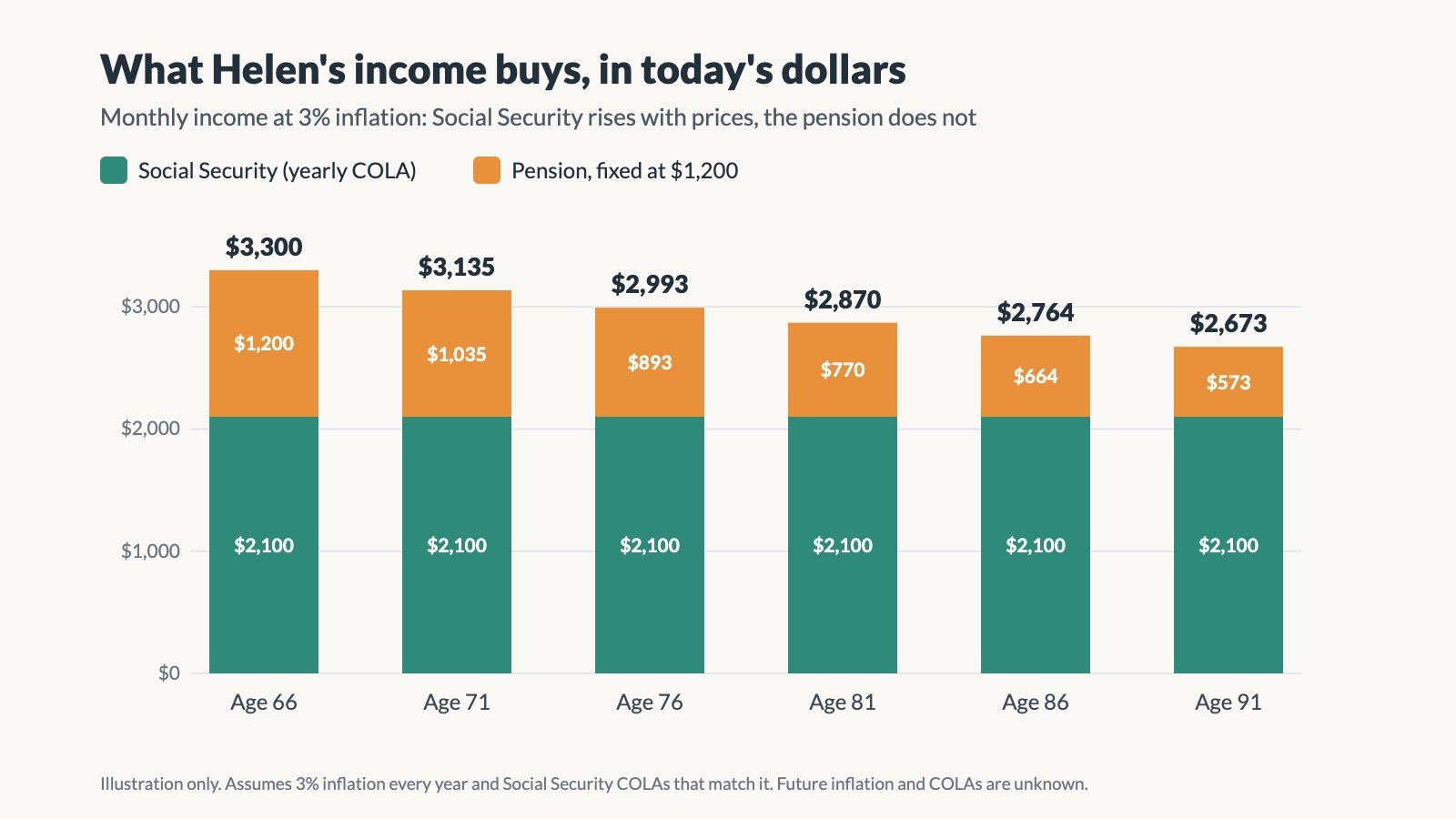
By 86, Helen’s total buying power is about 16% lower than when she retired, even though no check ever got smaller. Her savings have to fill that gap, on top of everything else they pay for.
How Social Security’s COLA works
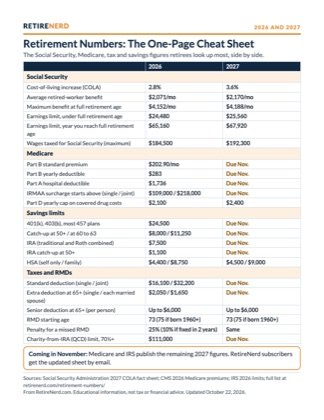
Each October, Social Security announces the next year’s cost-of-living adjustment, based on how much consumer prices rose over the past year. It takes effect with January’s payment. For 2027 the increase is 3.6%, which lifts the average retired worker’s check from about $2,095 to $2,170 a month.
Two details matter. First, Medicare Part B premiums usually come out of your Social Security check, and they tend to rise too, so the net increase is often smaller. A “hold harmless” rule keeps a Part B increase from shrinking most people’s check below the year before. Second, the COLA uses a price index based on working households, which may not match what retirees actually buy.
See this year’s figures on our retirement numbers page, and how your starting benefit is set in how Social Security calculates your benefit.
Ways retirees protect against inflation
No single tool solves inflation. Most people combine a few of these, depending on their income, savings and comfort with risk:
- Make Social Security larger. Each year you delay claiming, up to age 70, raises your starting benefit, and every future COLA is figured on that larger amount. See our Social Security guide.
- Inflation-linked bonds. TIPS and I bonds rise with inflation. I bonds are limited to $10,000 a person each year electronically. Our guide to TIPS ladders shows how retirees use TIPS for steady income.
- Keep part of your savings invested for growth. Over long periods, stocks have historically grown faster than prices, though they can drop sharply in any year.
- Plan withdrawals that adjust. Many withdrawal plans raise spending with inflation each year, and some add guardrails for bad markets. See how guardrails work.
- Check the inflation features on any annuity or pension choice. An option that rises each year starts lower, so compare how long it takes to catch up.
- Keep some spending flexible. Travel and other extras can shrink in a high-inflation year so basic bills stay covered.
Frequently asked questions
What inflation rate should I plan for?
The Federal Reserve’s long-run target is 2%. Many retirement planners use 2.5% to 3% in their projections to leave some room, and test what happens if inflation runs higher for a few years.
Does a big COLA mean I’m better off?
Not really. A large COLA usually follows a year of large price increases, so it mostly catches you up. It also doesn’t help any income that has no COLA, like Helen’s pension.
Are my health care costs rising faster than inflation?
They can. Medicare premiums, deductibles and out-of-pocket costs change every year and have often grown faster than overall prices. Our guide to Medicare costs shows the current figures.
Should I take a pension lump sum to protect against inflation?
It’s one reason some people do, because invested money can grow. But it also brings market risk and the risk of running out. Our guide to pension lump sum or monthly payments walks through the trade-off.
Your next step
List every source of retirement income and mark whether it rises with inflation. Then estimate what the fixed ones will be worth in 10 and 20 years: at 3% inflation, multiply today’s amount by about 0.74 for 10 years and 0.55 for 20. The gap is what your savings or other choices need to cover.
Helen ran that math and decided to keep about half her savings in stock funds for long-term growth and to buy I bonds each year. She also put off a kitchen remodel during a year when prices jumped. Her plan isn’t inflation-proof, but it is ready for it.
Related reading: how much you can safely withdraw and how to estimate your retirement spending.
Educational note: This article is general education, not individualized financial or investment advice. The figures are illustrations; future inflation, COLAs and investment returns are unknown. Helen is an illustrative example. A fee-only financial planner can help you test your own plan against different inflation rates.
Sources
- Social Security Administration: 2027 cost-of-living adjustment fact sheet
- Social Security Administration: Cost-of-living adjustment information
- Federal Reserve: Why does the Federal Reserve aim for inflation of 2 percent over the longer run?
- Bureau of Labor Statistics: Research CPI for Americans 62 and older (R-CPI-E)
- TreasuryDirect: I bonds
- TreasuryDirect: Treasury Inflation-Protected Securities (TIPS)
- Social Security Administration: How the hold harmless provision protects your benefits