
From 2025 through 2028, people 65 and older get a new tax deduction of up to $6,000 each. It is not the same as “no tax on Social Security,” and how much you get depends on your income. Here is who qualifies, how the phase-out works and how to plan around it.
Dolores is 68 and single. Her income is a pension, Social Security and withdrawals from her IRA. When she heard about the new senior deduction, she assumed it meant her Social Security was now tax-free. It does not. But it did lower her taxable income by $6,000, whether or not she itemizes, and it cut her federal tax by several hundred dollars.
Key takeaways
- Each person who is 65 or older by the end of the year can deduct up to $6,000, for tax years 2025 through 2028.
- It is on top of the standard deduction and the extra deduction for age 65, and itemizers get it too.
- It shrinks by 6% of income above $75,000 ($150,000 for married couples filing jointly) and is gone at $175,000 ($250,000).
- Married couples must file jointly, and each person needs a valid Social Security number.
In this article9 sections
What the senior deduction is
The 2025 federal tax law added a temporary deduction for older adults, which the IRS calls the enhanced deduction for seniors. It lowers your taxable income by up to $6,000 per qualifying person. A married couple where both spouses qualify can deduct up to $12,000.
It is separate from the extra standard deduction that people 65 and older already had, so you can get both. And unlike most deductions, you do not have to give up the standard deduction to claim it. Itemizers and non-itemizers both qualify.
Who qualifies
- Age: you must be 65 or older by December 31 of the tax year. For 2026, that means born before January 2, 1962.
- Years: tax years 2025, 2026, 2027 and 2028. It ends after 2028 unless Congress extends it.
- Filing status: married couples must file a joint return. Married filing separately does not qualify.
- Social Security number: each person claiming it needs a valid Social Security number.
- No Social Security benefits required: you qualify by age, whether or not you have claimed Social Security.
It is not “no tax on Social Security”
Many headlines described the new deduction as ending taxes on Social Security. The law did not change how benefits are taxed. Up to 85% of your benefits can still count as taxable income, using the same formula as before.
What changed is that you get an extra deduction against all your income. For many retirees with modest income, the extra $6,000 is enough to wipe out the tax on their benefits, which is where the headlines came from. See how Social Security benefits are taxed.
How the income phase-out works
The deduction shrinks once your modified adjusted gross income (MAGI) passes $75,000 ($150,000 for married couples filing jointly). For most people, MAGI is simply the adjusted gross income on Form 1040. Each person’s $6,000 is reduced by 6% of the income above the line.
Single filers
| Modified adjusted gross income | Senior deduction |
|---|---|
| $75,000 or less | $6,000 |
| $100,000 | $4,500 |
| $125,000 | $3,000 |
| $150,000 | $1,500 |
| $175,000 or more | $0 |
Married couples filing jointly, both 65 or older
| Modified adjusted gross income | Senior deduction (total for both) |
|---|---|
| $150,000 or less | $12,000 |
| $175,000 | $9,000 |
| $200,000 | $6,000 |
| $225,000 | $3,000 |
| $250,000 or more | $0 |
If only one spouse is 65 or older, the couple gets one deduction: $6,000 at $150,000 or less, falling to zero at $250,000.
What it adds up to in 2026
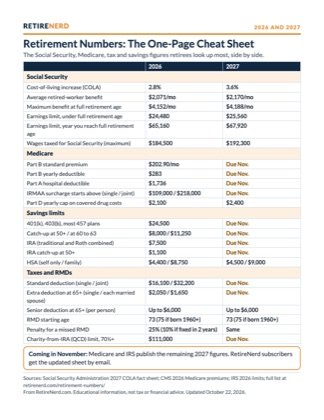
For a single filer 65 or older who takes the standard deduction, 2026 deductions can add up to $24,150: the $16,100 standard deduction, the $2,050 extra amount for age 65 and the $6,000 senior deduction.
For a married couple filing jointly with both spouses 65 or older, the total can reach $47,500: the $32,200 standard deduction, $1,650 extra for each spouse and $12,000 in senior deductions.
How much tax that saves depends on your bracket. At the 12% bracket, $6,000 of deduction saves $720; at 22%, it saves $1,320.
Planning around the phase-out
Inside the phase-out range, every extra $1,000 of income costs you $60 of deduction (or $120 for a couple when both qualify). At the 22% bracket, that adds roughly 1.3 percentage points to your tax rate on that income, or about 2.6 points for a couple. It is not huge, but it adds up with other income-based costs. A few ways to manage it:
- Give from your IRA with a QCD: a qualified charitable distribution keeps the gift out of your income entirely. See how qualified charitable distributions work.
- Size Roth conversions with the line in mind: a conversion raises MAGI for the year. Sometimes it is worth it anyway, but count the lost deduction as part of the cost. See the Roth conversion window before RMDs.
- Time large gains and withdrawals: spreading a big sale or withdrawal over two years can keep more of the deduction in both.
- Watch the other income lines too: the same income also sets your Medicare premiums two years later. See IRMAA: why your Medicare premium went up.
The deduction runs only through 2028, so the next three tax years are the window to plan around it. Our year-end retirement checklist shows when to check your income before the year closes.
How to claim it
You claim the senior deduction on Schedule 1-A, a new form that also covers the tips, overtime and car loan interest deductions. The amount carries over to your Form 1040. Tax software asks for your date of birth and figures it for you.
Because the deduction lowers your tax, you may be having too much withheld. If you have tax withheld from a pension, IRA withdrawals or Social Security, you can update your withholding with Form W-4P or W-4V, or lower your estimated tax payments. See how taxes affect your retirement withdrawals.
State taxes
The senior deduction is a federal deduction. Each state decides whether to follow it, and many states start from a different income figure or have their own senior exemptions. Check your state’s rules, and see which states tax retirement income.
Frequently asked questions
Do I have to be getting Social Security to claim it?
No. The deduction is based on age, not on receiving benefits. A 66-year-old who is still working and has not claimed Social Security can get it.
Can I take it if I itemize?
Yes. It is available whether you take the standard deduction or itemize.
My spouse is 63 and I am 67. Do we get $12,000?
No. Only the spouse who is 65 or older qualifies, so you get up to $6,000 on your joint return. Once your spouse turns 65 by the end of a year through 2028, you can claim up to $12,000 for that year.
Will it continue after 2028?
Under current law, no. The last year is 2028 unless Congress extends it.
Educational note: This article is general education, not tax advice. Tax rules can change, and your result depends on your income, filing status and state. Dolores is an illustrative example, and the tax savings shown are rounded. Check IRS guidance or a tax professional for your situation.