
If you are a veteran with VA health care, it is tempting to skip Medicare when you turn 65. Many veterans do, and some pay for it later. Here is how the two programs work side by side, what each one pays for and how to decide whether you need both.
Linda served in the Navy and has used her VA clinic for years. When she turned 65, she signed up for premium-free Part A but turned down Part B. Her VA care was working, so why pay a premium? Two years later her clinic was an hour away, and she wanted to see a cardiologist near home. Her VA coverage did not count as a reason to sign up late, so she had to wait for the General Enrollment Period. She now pays a Part B penalty for as long as she has Part B.
Key takeaways
- VA health care and Medicare are separate programs, and the VA does not bill Medicare for your care.
- Medicare pays for care from non-VA doctors and hospitals, while the VA pays only for VA care or care it authorizes in advance.
- VA coverage does not give you a Special Enrollment Period, so delaying Part B can mean a lifelong penalty.
- TRICARE For Life and CHAMPVA both require Part A and Part B once you are eligible for Medicare.
In this article9 sections
How VA health care and Medicare work together
The short answer: they mostly do not work together. Each program pays for its own kind of care, and they do not split the same bill.
The VA says it does not bill Medicare for your care. It may bill a Medicare supplement (Medigap) policy for covered services. Medicare, in turn, does not pay for care you get at a VA facility, even when Medicare would normally cover that service.
| Where you get care | Who pays |
|---|---|
| VA hospital, clinic or VA doctor | The VA. You may owe a VA copay for conditions not connected to your service, depending on your priority group. Medicare pays nothing. |
| Non-VA doctor or hospital the VA approved in advance (community care) | The VA. |
| Non-VA doctor or hospital the VA did not approve | Medicare, if you have it, after your deductible and coinsurance. Without Medicare, you pay. |
| Prescriptions from the VA pharmacy | The VA, with any VA drug copay. |
| Prescriptions at a local pharmacy | A Medicare drug plan (Part D), if you have one. |
Think of it as two separate doors. Walk through the VA door and the VA handles it. Walk through any other door and Medicare is your coverage, if you signed up.
Why the VA itself tells veterans to sign up for Medicare
It may surprise you, but the VA encourages veterans to enroll in Medicare as soon as they can. Its reasons:
- More choices. Medicare covers non-VA doctors and hospitals, so you can get care close to home, while traveling or when the VA has a long wait.
- VA funding can change. Your VA priority group decides what you pay, and veterans in lower priority groups could lose VA health benefits if funding changes. Medicare is a backup that does not depend on VA budgets.
- The Part B penalty. Waiting can cost you every month for the rest of your life, as Linda found.
Most people get Part A without a premium because they or a spouse paid Medicare taxes for at least 10 years. So the real decision is usually Part B, which has a monthly premium: $202.90 for most people in 2026 and $209.40 in 2027.
The Part B penalty many veterans do not see coming
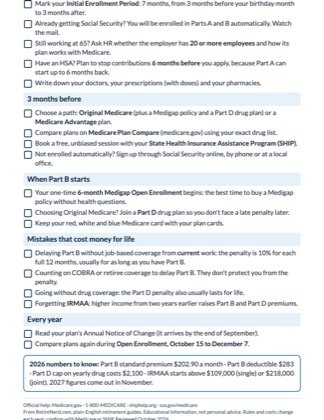
Your first chance to sign up is your Initial Enrollment Period. It starts 3 months before the month you turn 65 and ends 3 months after it.
People who keep job-based coverage from current work can usually delay Part B and sign up later without a penalty. VA health care does not work that way. It is not job-based coverage, so it does not give you a Special Enrollment Period. If you skip Part B at 65 and change your mind later, you generally have to sign up during the General Enrollment Period, January 1 to March 31, with coverage starting the month after you sign up.
The penalty adds 10% of the standard Part B premium for each full 12-month period you could have had Part B but did not. In most cases you pay it for as long as you have Part B.
| Full years without Part B | Penalty | Extra cost per month (2026 premium) | Extra cost per month (2027 premium) |
|---|---|---|---|
| 1 | 10% | $20.29 | $20.94 |
| 2 | 20% | $40.58 | $41.88 |
| 5 | 50% | $101.45 | $104.70 |
The penalty is based on the standard premium each year, so the dollar amount grows as the premium rises.
Do you need Part D if you have VA drug coverage?
Probably not right away. VA drug coverage counts as creditable coverage, which means Medicare treats it as at least as good as a standard Medicare drug plan. You can keep it and skip Part D without a late penalty.
Two things to know:
- You can have both VA drug coverage and a Part D plan, but you cannot use both for the same prescription.
- If you ever lose or drop VA coverage, sign up for Part D quickly. A gap of 63 days or more in a row without creditable drug coverage can trigger the Part D penalty.
Medicare says a Part D plan usually does not pay off for people with VA drug coverage unless they qualify for Extra Help. A Part D plan can still make sense if you want to fill prescriptions from non-VA doctors at a local pharmacy. If your income is limited, read Medicare Savings Programs and Extra Help to see whether you qualify for help with Part B and drug costs.
Medigap or Medicare Advantage alongside VA care
Once you have Parts A and B, you can choose how to handle the costs Medicare does not pay at non-VA doctors.
- Medigap (a Medicare supplement policy) pays some or all of Original Medicare’s deductibles and coinsurance. It lets you see any doctor in the country who takes Medicare. Medigap Explained covers the plans and the enrollment window.
- Medicare Advantage (Part C) replaces Original Medicare with a private plan, usually with a provider network. You can still use the VA, but the plan and the VA do not coordinate payment for the same care. Original Medicare vs. Medicare Advantage walks through the trade-offs.
If you plan to get nearly all your care at the VA, Part B alone may be enough. If you expect to use non-VA doctors often, extra coverage protects you from Medicare’s 20% coinsurance.
Military retirees: TRICARE For Life needs Part A and Part B
TRICARE For Life is the coverage for people with TRICARE, such as military retirees, once they have Medicare. It is not optional paperwork you can skip: you must have both Part A and Part B to keep TRICARE.
- Medicare pays first and TRICARE For Life pays second for most care in the United States.
- There is no TRICARE enrollment fee, but you pay the Part B premium.
- For services both Medicare and TRICARE cover, you usually pay nothing out of pocket.
- At a VA facility, Medicare pays nothing for conditions not connected to your service, so you may owe part of the bill.
One exception: if you or your spouse is on active duty, you do not need Part B to keep TRICARE while the service member is still serving. After retirement from active duty, an 8-month Special Enrollment Period lets you sign up without a penalty.
Spouses and survivors with CHAMPVA
CHAMPVA covers certain spouses, survivors and dependents of veterans with a permanent and total service-connected disability. If you have CHAMPVA and become eligible for Medicare, you must have Part A and Part B to keep CHAMPVA. A Medicare Advantage plan also meets this requirement.
A five-minute decision checklist
- Mark your Initial Enrollment Period on the calendar: 3 months before to 3 months after the month you turn 65.
- Sign up for Part A. It is premium-free for most people.
- If you have TRICARE For Life or CHAMPVA, sign up for Part B too. You need it to keep that coverage.
- If you have only VA care, ask yourself: will I ever want a non-VA doctor or hospital, near home or while traveling? If the answer could be yes, Part B at 65 avoids the penalty.
- Skip Part D for now if you rely on VA drug coverage, and set a reminder to join quickly if you ever leave the VA.
- Enter your birth date in My Retirement Dates to see your exact Medicare sign-up window and add it to your calendar.
For the full timeline of deadlines and penalties, see When to Sign Up for Medicare.
Frequently asked questions
Does Medicare pay for care at a VA hospital?
Generally, no. The VA does not bill Medicare, and Medicare does not pay for care you get at a VA facility, even for a service Medicare normally covers.
Can I wait to sign up for Part B because I have VA health care?
You can, but VA coverage does not give you a Special Enrollment Period. If you sign up later, you will usually wait for the General Enrollment Period and pay a lifelong penalty of 10% for each full year you went without Part B.
Will I pay a Part D penalty if I have VA drug coverage?
No, as long as you keep it. VA drug coverage is creditable, so you can join a Part D plan later without a penalty, as long as you never go 63 days or more in a row without creditable drug coverage.
Do I need Medicare if I have TRICARE?
Yes, once you are eligible for Medicare and the service member is no longer on active duty. TRICARE For Life requires both Part A and Part B, and Medicare pays first.
Educational note: This article explains general rules for VA health care, TRICARE, CHAMPVA and Medicare. Your costs depend on your VA priority group, service-connected conditions and other coverage. Before you decide, talk with your VA health benefits office, call Medicare at 1-800-MEDICARE or contact your State Health Insurance Assistance Program (SHIP) for free, unbiased counseling.
Sources
- U.S. Department of Veterans Affairs: VA health care and other insurance
- U.S. Department of Veterans Affairs: CHAMPVA benefits
- TRICARE: TRICARE For Life
- TRICARE: Care at a Veterans Affairs facility with Medicare and TRICARE
- Medicare.gov: When can I sign up for Medicare?
- Medicare.gov: Enrolling in Medicare Part A and Part B
- Medicare.gov: Your Guide to Medicare Drug Coverage
- CMS: Creditable coverage and late enrollment penalty