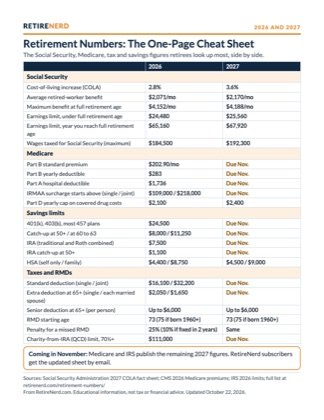

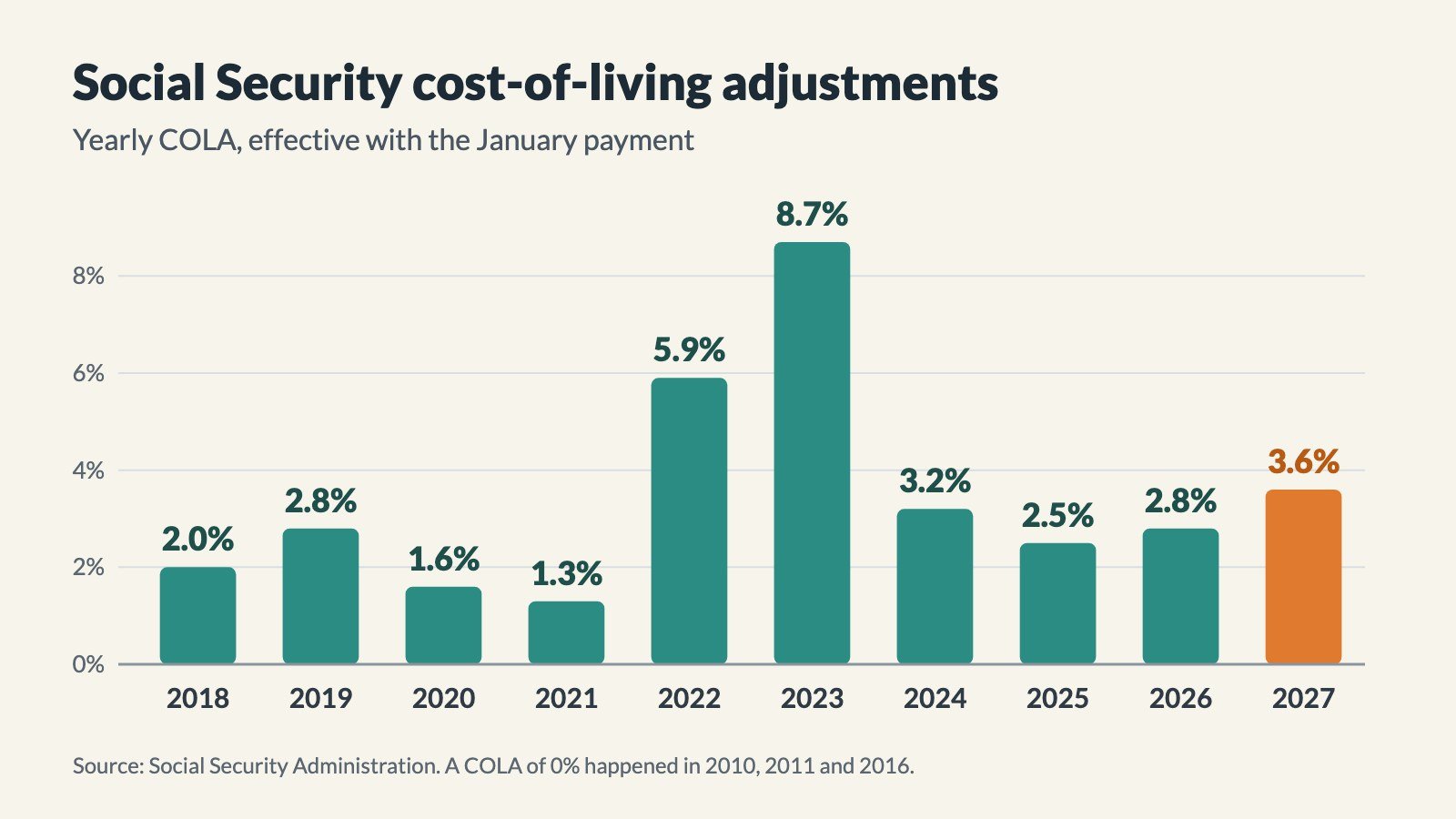
Social Security benefits go up 3.6% in 2027. That is the cost-of-living adjustment, or COLA, and it happens automatically. Here is how the raise is figured, when it lands in your account and why the deposit you see may grow by less than the headline number.
Ray is 70 and gets $2,400 a month from Social Security. A 3.6% raise is about $86. But Ray has Medicare, and his Part B premium comes out of his check before it reaches his bank. If the premium goes up too, part of his raise goes straight to Medicare. Knowing that ahead of time keeps January from feeling like a surprise.
Key takeaways
- Social Security and SSI benefits rise 3.6% for 2027, starting with the payment most people receive in January 2027.
- The COLA follows a price index for working households, comparing the third quarter of one year with the third quarter of the year before.
- The Medicare Part B premium comes out of most checks, so a premium increase can shrink the raise you actually see.
- You get credit for every COLA from the year you turn 62, even if you have not claimed benefits yet.
In this article10 sections
What the COLA is
A cost-of-living adjustment is a yearly raise that helps Social Security keep up with rising prices. It has been automatic since 1975, so you do not apply for it or sign anything. It applies to every kind of Social Security benefit: retirement, spousal, survivor and disability. Supplemental Security Income (SSI) gets the same percentage.
The COLA can be zero, but it cannot be negative. If prices do not rise, benefits stay the same. That happened in 2010, 2011 and 2016.
How the 2027 COLA was figured
The law ties the COLA to the Consumer Price Index for Urban Wage Earners and Clerical Workers (CPI-W), which the Bureau of Labor Statistics publishes each month. SSA averages the index for July, August and September and compares it with the same three months from the last year a COLA took effect.
| Step | 2027 COLA |
|---|---|
| Average CPI-W, July to September 2025 | 317.265 |
| Average CPI-W, July to September 2026 | 328.746 |
| Increase, rounded to the nearest tenth of a percent | 3.6% |
Because the September numbers come out in October, SSA announces the next year’s COLA every October. The 2027 COLA was announced on October 14, 2026.
When you will see it
The raise starts with your December benefit, which Social Security pays in January. Most people are paid on a Wednesday chosen by their birth date:
| Your birth date | Payment day | First raised payment |
|---|---|---|
| 1st to 10th | Second Wednesday | January 13, 2027 |
| 11th to 20th | Third Wednesday | January 20, 2027 |
| 21st to 31st | Fourth Wednesday | January 27, 2027 |
If you started benefits before May 1997, or you get both Social Security and SSI, your Social Security is paid on the 3rd of the month instead. SSI recipients see their raise first: the January 2027 SSI payment goes out on December 31, 2026.
Your exact new amount is in your COLA notice. Most people with a my Social Security account created by November 18, 2026, can read it online in the account’s Message Center starting in late November. Paper notices arrive by mail in December.
Why your deposit may rise by less
The 3.6% applies to your benefit before deductions. What reaches your bank is what is left after anything Social Security takes out, mainly the Medicare Part B premium and any federal tax you asked them to withhold. Here is Ray’s example:
| Ray’s check | 2026 | 2027 (example) |
|---|---|---|
| Benefit before deductions | $2,400 | $2,486 |
| Medicare Part B premium | $203 | $209 |
| Deposit | $2,197 | $2,277 |
| Raise he actually sees | $80 a month, not $86 |
The standard Part B premium for 2027 is $209.40 a month, up from $202.90, as announced by the Centers for Medicare & Medicaid Services (CMS). The table rounds both. Your COLA notice shows your own amount. Small differences also come from rounding: SSA rounds benefit amounts down at a few steps, so your raise can be a dollar or so less than 3.6% of your old check.
The hold harmless rule
For most people who already have Part B taken out of their Social Security, a “hold harmless” rule keeps a Part B increase from making the deposit smaller than the year before. If your raise in dollars is less than the premium increase, your premium goes up only as much as your raise.
The rule does not protect you if you are new to Part B that year, if you pay the higher-income surcharge known as IRMAA, or if Medicaid pays your premium. See IRMAA: why your Medicare premium went up and how much Medicare costs.
The COLA counts even before you claim
You become eligible for COLAs starting with the year you turn 62, whether or not you have started benefits. If you turned 62 in 2023 and wait until 70 to claim, your starting benefit already includes every COLA from 2023 on, plus the credits you earned for waiting.
So delaying does not cost you the raises. They are built into the larger check you start with, and every future COLA is figured on that larger amount. See claiming at 62, 67 or 70 and how Social Security calculates your benefit.
Other numbers that change for 2027
The same October announcement updates the limits that matter if you still work or have not claimed yet:
| Figure | 2026 | 2027 |
|---|---|---|
| Earnings limit if you are under full retirement age all year | $24,480 | $25,560 |
| Earnings limit in the year you reach full retirement age | $65,160 | $67,920 |
| Maximum earnings taxed for Social Security | $184,500 | $192,300 |
| Earnings needed for one work credit | $1,890 | $1,970 |
| Maximum benefit at full retirement age (monthly) | $4,152 | $4,188 |
| SSI federal payment, individual (monthly) | $994 | $1,029 |
SSA estimates the average retired worker’s benefit goes from $2,095 to $2,170 a month with the 2027 COLA, about $75 more. If you are working while collecting, see claiming Social Security while you keep working. For every yearly figure in one place, see the retirement numbers page.
Taxes and the COLA
A bigger benefit can mean more of it is taxable. Up to 85% of Social Security can count as taxable income once your income passes $25,000 (single) or $32,000 (married filing jointly). Those lines are not adjusted for inflation, so COLAs slowly push more retirees over them. See how Social Security benefits are taxed.
If you have federal tax withheld from your benefit with Form W-4V, it is a percentage (7%, 10%, 12% or 22%), so the withholding rises with your benefit automatically. It is still worth checking once a year that the amount fits your tax bill.
Does the COLA keep up with your costs?
The COLA is based on prices for working households. Retirees often spend more on health care and housing, which can rise faster than the average. And the COLA only covers Social Security. A pension or annuity with no inflation adjustment loses buying power every year. For the bigger picture, see inflation in retirement.
What to do this winter
- Read your COLA notice online in late November or by mail in December. Check the new benefit and the Part B amount.
- Update your budget with the deposit amount, not the 3.6%.
- Check your tax withholding if your income is near the taxable lines.
- Ignore anyone who calls about your raise. The COLA is automatic. Social Security will never ask for fees, gift cards or personal information to give it to you. See how to protect your retirement savings from scams.
Frequently asked questions
Do I need to do anything to get the COLA?
No. It is automatic for everyone getting Social Security or SSI.
Why is my raise less than 3.6% of my check?
Usually because the Medicare Part B premium went up too, and it comes out before the deposit. SSA also rounds amounts down, which can trim a dollar or so.
Does the COLA apply to spousal and survivor benefits?
Yes. Every Social Security benefit rises by the same percentage, including spousal, survivor and disability benefits. See Social Security spousal benefits.
Can benefits go down if prices fall?
No. If the index does not rise, there is no COLA that year, but benefits are not cut.
I have not claimed yet. Do I miss out on this year’s COLA?
No. From the year you turn 62, each COLA is added to your benefit amount, so it will be part of your check whenever you start.
Educational note: This article is general education, not financial or tax advice. Ray is an illustrative example, and his table uses the standard 2027 Part B premium announced by CMS. Your COLA notice from Social Security shows your exact figures. For questions about your benefit, contact Social Security, and for tax questions, a tax professional.
Sources
- Social Security Administration: Cost-of-Living Adjustment (COLA) Information
- Social Security Administration: 2027 COLA Fact Sheet
- Social Security Administration, Office of the Chief Actuary: Latest Cost-of-Living Adjustment
- Social Security Administration: Your Retirement Benefit: How It’s Figured
- Social Security Administration: Schedule of Social Security Benefit Payments 2027
- Social Security Administration: How the Hold Harmless Provision Protects Your Benefits
- Social Security Administration: Request to Withhold Taxes