A pension offer can feel like a test with one chance to get it right. Here is how to compare a lump sum with monthly payments, what the lump sum would have to earn, and the questions to ask before you sign.
Gary turned 65 this year and opened a thick envelope from his former employer. He could take his pension three ways: $2,000 a month for life, $1,780 a month for life with the same amount continuing to his wife, Denise, if he dies first, or a single payment of $330,000.
$330,000 sounded like a lot more money than $2,000 a month. His brother told him to take the cash and invest it. His neighbor said a check that never stops is worth more than any investment.
Both could be right, depending on Gary. The choice is usually permanent, so it is worth an evening with a calculator before he signs anything.
Key takeaways
- Monthly pension payments last for life, while a lump sum gives you control but can run out.
- In our example, a $330,000 lump sum would need to earn about 5.4% a year to match $2,000 a month until age 90.
- A married worker needs a spouse’s signed, witnessed consent to take a lump sum or a payment that stops at death.
- Roll a lump sum directly into an IRA to avoid paying tax on the whole amount at once.
Your three usual choices
| Option | How it pays | Main trade-off |
|---|---|---|
| Single-life annuity | The highest monthly check, for as long as you live | Stops when you die, so a spouse gets nothing more |
| Joint and survivor annuity | A smaller check, and part or all of it continues to your spouse for life | Lower income now in exchange for protecting your spouse |
| Lump sum | One payment you can roll into an IRA and invest | You take on the investment risk and the risk of running out |
Joint and survivor options usually come in 50%, 75% and 100% versions, which is the share of your check your spouse keeps. Some plans also let you take part of the pension as a lump sum and the rest as monthly payments.
What the lump sum would have to earn
Here is a simple way to compare. Imagine Gary takes the $330,000, invests it, and pays himself the same $2,000 a month the pension would have paid. How long does the money last?
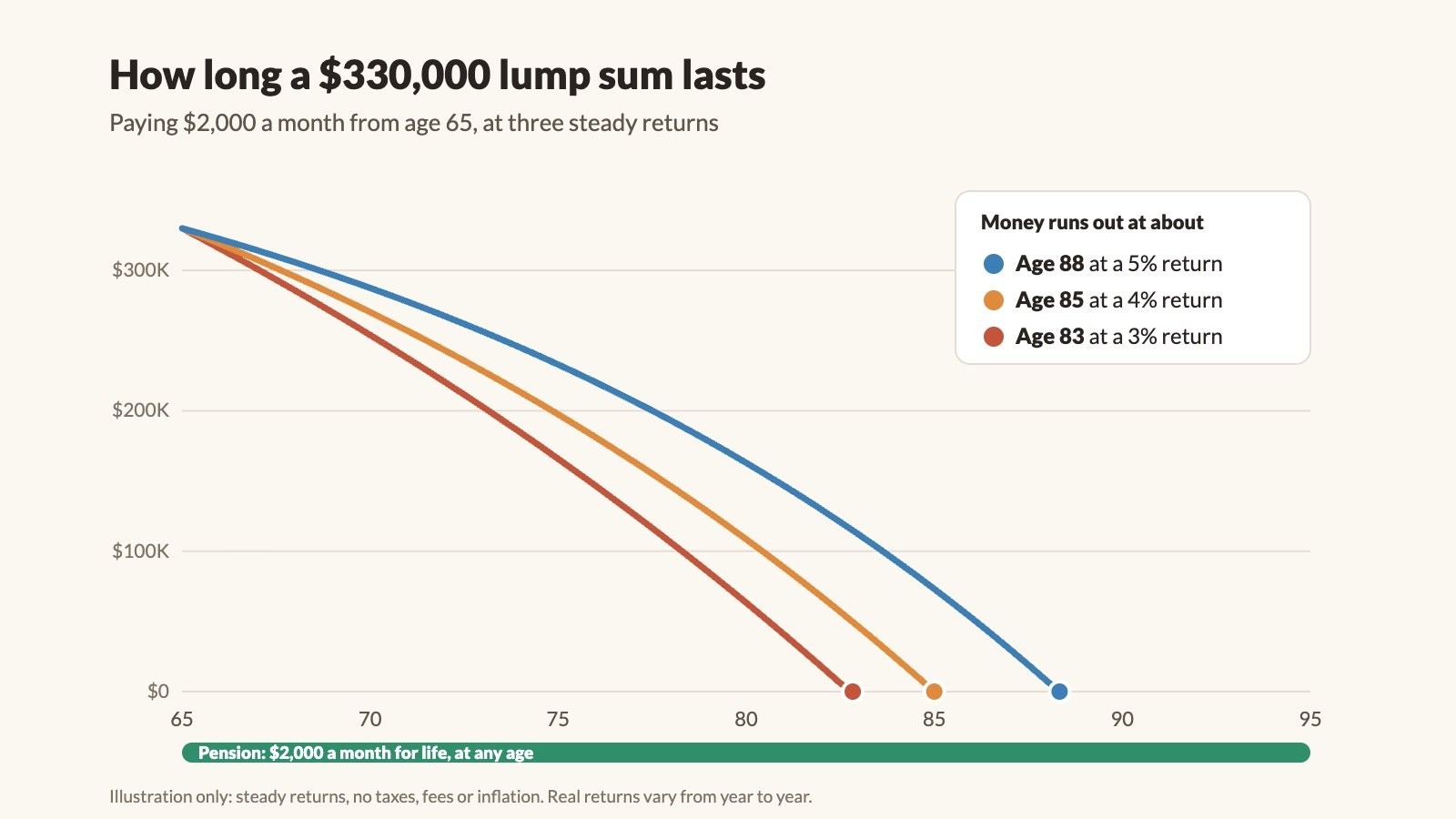
At a steady 4% return, the money runs out at about 85. At 5%, it lasts to about 88. To keep paying $2,000 a month until age 90, it would need to earn about 5.4% every single year, with no bad stretches in the market.
That doesn’t mean the lump sum is a bad deal. Gary could spend less, leave some to Denise or his children, or use the money flexibly. But it shows what he gives up: a paycheck that can’t run out, however long he lives and whatever markets do.
One more thing to know: most private pensions don’t rise with inflation. $2,000 today will buy less in 20 years. A lump sum can be invested to keep up, but only if it earns enough. Our guide to income annuities covers the same trade-off from the insurance side.
When each choice tends to fit
Monthly payments often fit if you:
- Are in good health and come from a long-lived family
- Need the income to cover basic bills alongside Social Security
- Don’t want to manage investments, or worry about markets
- Want to protect a spouse with a survivor benefit
A lump sum often fits if you:
- Have other secure income that already covers your basic bills
- Have serious health concerns that make a long retirement less likely
- Want to leave money to children or other heirs
- Are comfortable investing, or work with someone you trust, and won’t be tempted to spend it early
Questions to ask your plan before you sign
- Does the monthly payment ever increase for inflation?
- What are the exact survivor options and amounts?
- What interest rate was used to calculate the lump sum, and when does it change? Lump sums usually shrink when interest rates rise.
- Can I take part as a lump sum and part as monthly payments?
- Does retiree health coverage or any other benefit depend on which option I choose?
- What is the deadline to decide, and can I change my mind before payments start?
Your spouse has to sign
For most private pensions, federal law makes a joint and survivor annuity the default for married workers. To choose a lump sum or a single-life payment instead, your spouse must agree in writing, and the signature must be witnessed by a notary or a plan representative.
Treat it as a decision for both of you. If Gary takes the single-life $2,000 and dies at 72, Denise’s check from the plan stops. The $1,780 joint option costs $220 a month while Gary is alive, but it pays Denise for the rest of her life.
Taxes and the rollover
Monthly pension payments are taxed as ordinary income each year you receive them. A lump sum paid to you is all taxable that year, and the plan must withhold 20% for federal tax.
To avoid that, ask for a direct rollover into an IRA. The money moves straight from the plan to the IRA, no tax is due yet, and you pay tax later as you withdraw it. If you are younger than 59½, check the early withdrawal rules before moving money out of the plan, because some penalty exceptions apply only while the money stays in the employer plan.
Is my pension safe if the company fails?
Most private pensions are insured by the Pension Benefit Guaranty Corporation, a federal agency. If a plan fails, the PBGC pays benefits up to a legal limit. For plans that end in 2026, the limit for a 65-year-old taking a single-life pension is $93,477 a year, about $7,790 a month, and lower at younger ages or with a survivor benefit. Most people’s pensions are below that limit.
Government pensions aren’t covered by the PBGC; they depend on the state or public employer.
Frequently asked questions
Can I change my mind later?
Usually not after payments start. Monthly payments are generally locked in for life, and a lump sum, once paid, can’t be turned back into a pension. Ask your plan about the deadline and whether you can revoke your choice before it takes effect.
Why did my lump sum offer go down?
Lump sums are calculated with interest rates the IRS publishes. When rates rise, the same monthly pension is worth a smaller lump sum today, so offers can drop from one year to the next.
How does this affect Social Security?
It doesn’t change your Social Security benefit. Since 2025, a government pension no longer reduces Social Security either. Our guide to spousal benefits explains that change.
Could a lump sum raise my Medicare premiums?
Yes, if you take it as cash rather than rolling it over, because the whole amount counts as income that year. See IRMAA, explained.
Your next step
Write down your monthly offer and your lump sum, then divide the lump sum by twelve times the monthly amount. That tells you how many years of payments the lump sum equals before any growth. For Gary, $330,000 divided by $24,000 is just under 14 years. Then ask yourself, and your spouse, how long you expect to need the money.
Gary and Denise chose the joint pension. With Social Security, it covers their basic bills for life, and they invest their 401(k) for everything else.
Related reading: how to create a retirement paycheck and what happens to your 401(k) after retirement.
Educational note: This article is general education, not individualized financial, tax or legal advice. The example uses steady returns and ignores taxes, inflation and fees; real investment returns vary from year to year. Gary and Denise are an illustrative example. A fee-only financial planner can run the numbers on your own pension offer.
Sources
- IRS: Retirement topics, qualified joint and survivor annuity
- U.S. Department of Labor: FAQs about retirement plans and ERISA
- IRS: Rollovers of retirement plan and IRA distributions
- PBGC: Maximum monthly guarantee tables
- PBGC: FY 2025 Annual Report (2026 guarantee limits)
- IRS: Minimum present value segment rates