
Retiring in your 50s is a goal for many people. The catch is that most retirement accounts charge a penalty if you touch them before 59½. Here are the legal ways around it, including the rule of 55, and the one mistake that can close the door.
Linda was 56 when her company offered an early retirement package. She had $380,000 in her company 401(k) and $150,000 in an IRA from an old job. She planned to live on her savings until 62, when she would claim Social Security.
A friend gave her what sounded like tidy advice: roll everything into one IRA so it’s all in one place. If Linda had done that, she would have paid an extra 10% on every dollar she took out for the next three and a half years.
Linda didn’t know about the Rule of 55. Plenty of people don’t. Here is how it works, along with the other ways to reach retirement money early.
Key takeaways
- Withdrawals from a 401(k) or IRA before age 59½ usually cost an extra 10% tax on top of regular income tax.
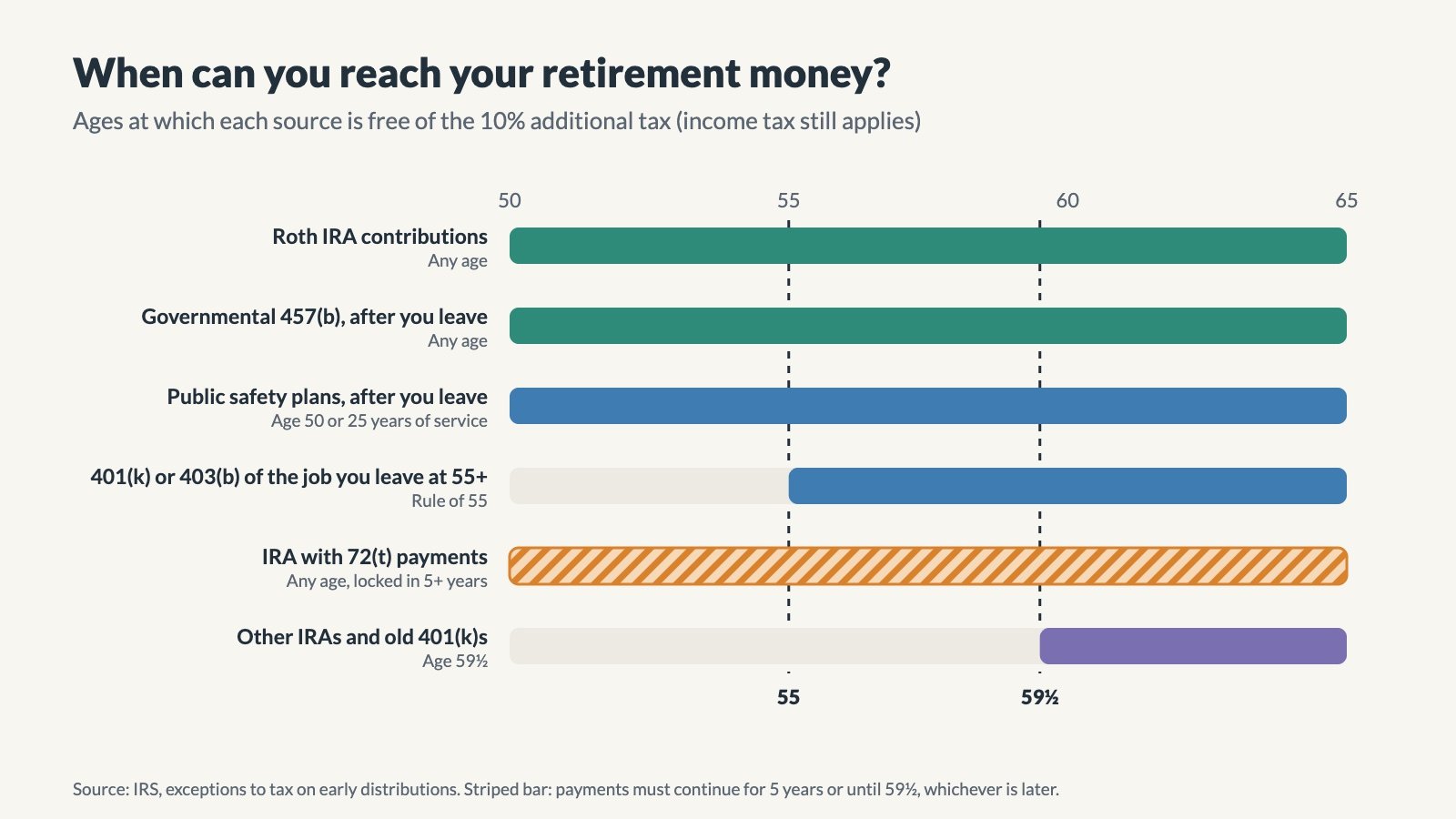
- The Rule of 55 lets you take money without that 10% from the 401(k) of the job you leave in or after the year you turn 55.
- Rolling that 401(k) into an IRA ends the Rule of 55 for that money until you reach 59½.
- 72(t) payments can open an IRA at any age, but you must keep the same payments going for at least five years or until 59½.
Why 59½ matters
The IRS adds a 10% additional tax to most withdrawals from 401(k)s, 403(b)s and IRAs taken before age 59½. It sits on top of the regular income tax you already owe on the money.
So a $40,000 withdrawal could cost $4,000 in extra tax before income tax is even counted. The exceptions below remove the 10%, not the income tax. Penalty-free is not the same as tax-free.
The Rule of 55
If you leave your job in or after the calendar year you turn 55, you can take money from that employer’s 401(k) or 403(b) without the 10% additional tax. It doesn’t matter whether you retire, quit, get laid off or are fired.
| Covered by the Rule of 55 | Not covered |
|---|---|
| The 401(k) or 403(b) of the employer you just left | IRAs, including a rollover IRA |
| Leaving in the year you turn 55, even if you leave before your birthday | Leaving at 54 in a year you don’t turn 55, then waiting |
| Money already sitting in that plan, including old accounts you rolled into it before leaving, if the plan allows | 401(k)s from earlier employers that you never rolled into this plan |
Public safety workers get an earlier start. Police officers, firefighters, emergency medical workers and corrections officers in a state or local government plan can use the same rule at age 50, or after 25 years of service if that comes first. Private-sector firefighters qualify too.
If you work for a state or local government, check whether you have a governmental 457(b) plan. Money from that plan has no 10% additional tax at any age once you leave the job, except for amounts rolled in from other kinds of plans.
The rollover trap
Rolling a 401(k) into an IRA is often a good move. You may get more investment choices and fewer accounts to track. But the moment the money lands in an IRA, the Rule of 55 no longer applies to it. It stays behind the 59½ line.
Linda’s gap was $42,000 a year for six years, about $252,000 before taxes. Keeping at least that much in her 401(k) let her draw it penalty-free. Moving it all to an IRA would have cost about $4,200 a year in extra tax until 59½.
Before you decide, ask your plan three things. Does it allow partial withdrawals after you leave, or only one full payout? How much federal tax does it withhold? Plans usually withhold 20% from a lump-sum payment made to you. And can you set up regular payments, such as monthly? Our guide to what happens to your 401(k) after you retire covers the rollover choices in more detail.
72(t) payments: a way into an IRA early
If your money is in an IRA, or you leave work before 55, there is another option. Section 72(t) of the tax code lets you take substantially equal periodic payments from an IRA at any age without the 10% additional tax.
The catch is commitment. Once payments start, you must keep them going for five years or until you reach 59½, whichever comes later. If you change the amount or skip a year, the IRS adds back the 10% tax on every payment you took, plus interest.
Take Mark, 52, who has $500,000 in an IRA. The IRS allows three ways to set the payment, using his life expectancy (34.3 years at age 52) and, for two of them, an interest rate of up to 5% or 120% of a federal rate, whichever is higher.
| Method | How it works | Mark’s first-year payment |
|---|---|---|
| Required minimum distribution | Balance divided by life expectancy, recalculated every year | About $14,600, changing each year |
| Fixed amortization | Spreads the balance like a loan payment over his life expectancy | About $30,800 a year at 5%, fixed |
| Fixed annuitization | Uses an annuity factor from IRS mortality tables | Usually close to the amortization amount |
Mark starts at 52, so he is locked in until 59½, seven and a half years. The rules allow one change: a single switch from a fixed method to the required minimum distribution method, which usually lowers the payment.
Mark only needs $20,000 a year, so he doesn’t have to use his whole IRA. He can first split it into two IRAs and run 72(t) on the smaller one. About $325,000 produces roughly $20,000 a year at 5%, and the rest stays untouched.
Other ways to reach money before 59½
- Roth IRA contributions. The amounts you put into a Roth IRA, not the growth, can come out at any age without tax or penalty. Money you converted to a Roth has its own five-year wait.
- Cash and taxable accounts. A savings account or regular brokerage account has no age rules at all. It is often the simplest money to use first.
- A few specific exceptions. The IRS waives the 10% for certain situations, listed below.
| Exception | 401(k) and similar plans | IRAs |
|---|---|---|
| Total and permanent disability | Yes | Yes |
| Unreimbursed medical bills above 7.5% of your adjusted gross income | Yes | Yes |
| Health insurance premiums while unemployed | No | Yes |
| One emergency withdrawal a year, up to $1,000 | Yes | Yes |
| Birth or adoption, up to $5,000 per child | Yes | Yes |
| First home purchase, up to $10,000 | No | Yes |
| Higher education costs | No | Yes |
Health coverage is the other big question for anyone retiring before 65. Our guide to health insurance before Medicare walks through the options.
Frequently asked questions
Does the Rule of 55 work if I’m laid off or fired?
Yes. The IRS only asks that you separate from the employer in or after the year you turn 55. The reason you leave doesn’t matter.
Can I work again after using the Rule of 55?
Yes. A new job doesn’t stop withdrawals from the old employer’s plan. Just remember that the rule covers only the plan from the job you left at 55 or later.
I left my job at 53. Can I use the Rule of 55 when I turn 55?
No. The rule looks at the year you left. For that account, your options are 72(t) payments (often after rolling it to an IRA) or waiting until 59½.
Can I stop 72(t) payments if I go back to work?
Not without consequences. Stopping or changing the payments before the end date brings back the 10% tax on all the payments so far, plus interest. The exceptions are death and disability.
Do these withdrawals raise my taxes?
They count as ordinary income, just like a paycheck. Taking money in years when your income is low can keep the tax bill down. See how taxes affect your retirement withdrawals.
Your next step
If you’re thinking about leaving work before 59½, list each account you own and the age it opens. Then, before your last day, call your 401(k) plan and ask whether it allows partial withdrawals after you leave. That one answer tells you whether to keep money in the plan or move it.
Linda kept $260,000 in her company 401(k) and set up monthly withdrawals. She rolled the rest into her IRA, which she plans to leave alone until her 60s. She paid no 10% penalty.
Related reading: which account to draw from first, the hidden cost of raiding your 401(k) and how to create a retirement paycheck.
Educational note: This article is general education, not individualized tax, legal or financial advice. The 72(t) figures are illustrations; the exact payment depends on your balance, age, method and the rate used. Linda and Mark are illustrative examples. A CPA or fee-only financial planner can check your own numbers before you take money out.
Sources
- IRS: Retirement topics, exceptions to tax on early distributions
- IRS: Retirement topics, tax on early distributions
- IRS: Topic no. 558, additional tax on early distributions from retirement plans other than IRAs
- IRS: Substantially equal periodic payments
- IRS: Notice 2022-6, determining substantially equal periodic payments
- IRS: Publication 590-B, distributions from IRAs
- IRS: Publication 575, pension and annuity income