
Several of the most useful money moves in retirement have a hard deadline of December 31. Miss it, and the chance is gone for the year or comes with a penalty. Here is what to check in November and December, in the order the deadlines arrive.
Ruth is 74 and has been retired for nine years. For a long time she took her required withdrawal in a rush every December, gave to her church by check, and only thought about taxes in April.
Two years ago she made one change: she started her year-end review in early November. Now her IRA sends her yearly gift straight to the church, which also counts toward her required withdrawal and keeps it off her tax return. She compares drug plans before December 7 and checks her tax bracket before the year closes. It takes her about an afternoon.
Key takeaways
- Required minimum distributions, qualified charitable distributions and Roth conversions must be done by December 31.
- Medicare Open Enrollment ends December 7. Plan changes made by then start January 1.
- Your income this year affects your taxes, your senior deduction and your Medicare premiums two years from now.
- Start in early November: banks and IRA custodians get busy in late December, and some moves take days to complete.
In this article12 sections
The year-end calendar at a glance
| Deadline | What to finish |
|---|---|
| December 7 | Medicare Open Enrollment: change a Medicare Advantage or Part D plan for next year |
| December 31 | Required minimum distributions (except a first one), qualified charitable distributions, Roth conversions, investment sales for tax purposes, 401(k) payroll contributions, gifts to family and charity |
| January 15 | Fourth-quarter estimated tax payment |
| January 1 to March 31 | Medicare Advantage Open Enrollment: one plan change if you are in a Medicare Advantage plan |
| April 1 | Your first required minimum distribution, if you reached RMD age last year and waited |
| April 15 (tax filing deadline) | IRA and HSA contributions for the year just ended; removing any excess contributions |
1. Take your required minimum distribution
Once you reach RMD age (73 if you were born from 1951 to 1959, 75 if you were born in 1960 or later), you must take a minimum amount out of traditional IRAs and most workplace plans every year by December 31. Roth IRAs have no RMDs while the owner is alive.
- First year: your first RMD can wait until April 1 of the next year. But then you take two RMDs in one tax year, which can push you into a higher bracket and raise your Medicare premiums later.
- Several IRAs: you figure the RMD for each IRA, then can take the total from any one of them. A 401(k) RMD must come from that 401(k).
- Inherited accounts: many heirs must take a yearly withdrawal from an inherited IRA as well. See the 10-year rule for inherited IRAs.
- Missed RMD: the penalty is 25% of the amount not taken, cut to 10% if you fix it within two years. Take the missed amount as soon as you notice and file Form 5329.
Ask your custodian for the RMD amount, or use our RMD calculator. For the full rules, see required minimum distributions, explained.
2. Give from your IRA with a qualified charitable distribution
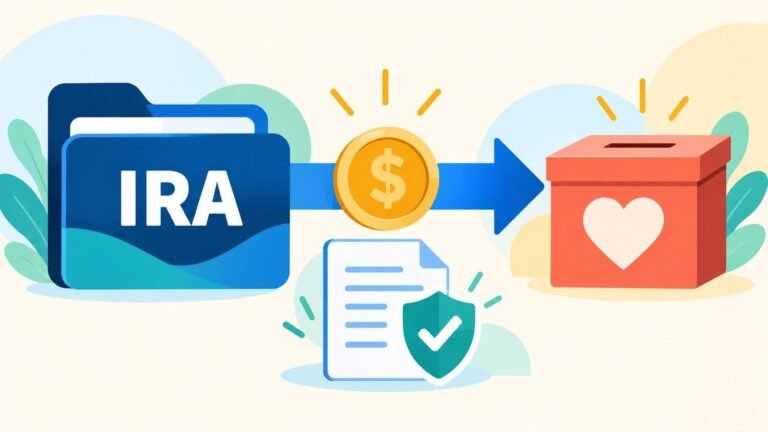
If you are 70½ or older and give to charity, a qualified charitable distribution (QCD) is often the most tax-friendly way to do it. Your IRA sends money directly to a qualified charity, up to $111,000 in 2026 ($114,000 in 2027). The gift is left out of your taxable income, and once you reach RMD age it counts toward your RMD.
Because a QCD lowers your income instead of adding a deduction, it helps even if you take the standard deduction. It can also keep your income below the thresholds for the senior deduction and higher Medicare premiums. Three rules to watch:
- The money must go from the IRA straight to the charity. If the check is made out to you, it is a regular taxable withdrawal.
- Donor-advised funds and private foundations do not qualify.
- Your Form 1099-R will show the full amount. Tell your tax preparer it was a QCD so it is reported correctly.
Ask your custodian in November. A QCD must leave the IRA by December 31, and custodians get many requests in the last weeks of the year. For the full rules and steps, see our guide to qualified charitable distributions.
3. Plan other charitable gifts under the new rules
Starting in 2026, the rules for deducting gifts to charity changed:
- If you take the standard deduction: you can now deduct up to $1,000 of cash gifts to qualified charities ($2,000 for married couples filing jointly). Gifts to donor-advised funds do not count.
- If you itemize: only the part of your charitable gifts above 0.5% of your adjusted gross income is deductible.
- Gifts of stock: giving shares you have held more than a year, instead of selling them, avoids the capital gains tax on the growth.
Gifts must be made by December 31 to count this year. A check counts on the date you mail it; a credit card gift counts on the date it is charged.
4. Look at your tax bracket before the year closes
In December you know most of your income for the year, so you can see how much room is left in your tax bracket. That makes it a good time for three moves:
- Roth conversions: converting part of a traditional IRA to a Roth IRA counts in the year it happens, so the deadline is December 31. A conversion cannot be undone later. See how to convert to a Roth step by step and the Roth conversion window before RMDs.
- The 0% capital gains rate: long-term gains are taxed at 0% while your taxable income stays at or below $49,450 ($98,900 for married couples filing jointly) in 2026. If you are under that line, you may be able to sell investments with gains and pay no federal tax on them.
- Selling at a loss: losses in a taxable account can offset gains and up to $3,000 of other income. If you buy the same investment back within 30 days before or after the sale, the loss is not allowed.
Before you add income, check these income lines:
- Senior deduction: from 2025 through 2028, people 65 and older can deduct an extra $6,000 each. It starts to shrink once modified adjusted gross income passes $75,000 ($150,000 for joint filers). See how the senior deduction works.
- Medicare premiums: your income this year sets your Part B and Part D premiums two years from now. See IRMAA: why your Medicare premium went up.
- Social Security taxes: more income can make more of your benefit taxable. See how Social Security benefits are taxed.
- Marketplace coverage: if you retired before 65 and buy health insurance on the Marketplace, your income for the year sets your premium tax credit. See the ACA before Medicare.
5. Check your withholding and estimated taxes
Retirees often owe a penalty because no employer is withholding tax for them. You generally avoid the penalty if what you paid during the year covers 90% of this year’s tax or 100% of last year’s (110% if your adjusted gross income was over $150,000). Our guide to paying taxes in retirement explains the rules and the due dates.
- A December fix: tax withheld from an IRA withdrawal counts as if it were paid evenly through the year. If you are short, having extra tax withheld from your December RMD can close the gap.
- Estimated payments: the fourth-quarter payment for the year is due January 15.
- Social Security: you can have 7%, 10%, 12% or 22% of your benefit withheld for next year by filing Form W-4V.
For more on planning withdrawals around taxes, see how taxes affect your retirement withdrawals.
6. Finish contributions if you are still working
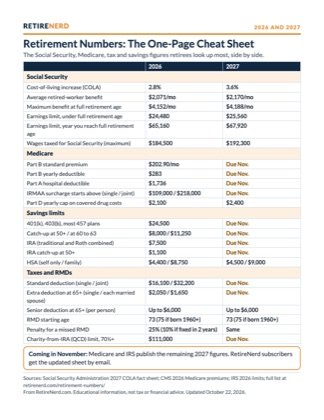
401(k), 403(b) and most 457 plan contributions must come out of a paycheck by December 31. For 2026, the limit is $24,500, plus a catch-up of $8,000 at 50 or older, or $11,250 if you are 60 to 63. If your wages last year were over $150,000, your catch-up contributions must go in as Roth. For 2027, the limit rises to $25,500, with catch-ups of $8,500 and $11,750, so January is a good time to raise your paycheck contribution. If your 2026 wages are over $155,000, your 2027 catch-ups must go in as Roth.
IRA and HSA contributions for the year can be made until the tax filing deadline in April. Remember that HSA contributions must stop once you are on Medicare. See HSAs in retirement.
7. Review Medicare and health spending
- Open Enrollment, October 15 to December 7: read your plan’s Annual Notice of Change and compare plans on Medicare.gov, even if you liked your plan this year. Drug lists and costs change every January. In 2027, the yearly cap on covered drug costs is $2,400. See how to compare Part D plans.
- Medigap: outside your first enrollment period, switching Medigap plans may require answering health questions in most states. See Medigap explained.
- Deductibles: if you have already met this year’s deductibles, care you schedule before December 31 may cost less than the same care in January.
- Flexible spending accounts: if you or a working spouse has one, check the deadline to use the balance. Some plans allow a short grace period or a small carryover; the rest is lost.
8. Make gifts to family
In 2026 you can give up to $19,000 to each person without filing a gift tax return ($38,000 if you and your spouse both give). In 2027 it rises to $20,000 per person ($40,000 for a couple). The limit resets every January, so unused room does not carry over. Paying someone’s tuition or medical bills directly to the school or provider does not count toward the limit.
A check counts as a gift once it is cashed, so give it early enough for the person to deposit it by December 31. Large lifetime gifts are rarely taxed, but they need a gift tax return. See gifting to family in retirement and estate planning basics.
9. Update paperwork and plan next year
- Beneficiaries: check the beneficiary on each IRA, 401(k), HSA, annuity and life insurance policy. They override your will.
- Next year’s income: Social Security goes up 3.6% in January 2027. Your new benefit amount and Medicare premium arrive by letter and in your my Social Security account. See retirement numbers for 2027, and for why your deposit may rise by less, how the Social Security COLA works.
- Your cash reserve: refill the cash you plan to spend next year. See how much cash to keep in retirement.
- Your withdrawal plan: decide which accounts will pay for next year. See how to create a retirement paycheck.
- Scam check: fake Medicare and IRS calls rise during Open Enrollment and tax season. See avoiding scams.
Your year-end checklist
- Early November: ask your IRA custodian for your RMD amount and request any QCD.
- By December 7: compare Medicare plans and make any change for next year.
- Early December: estimate this year’s income and decide on a Roth conversion or investment sales.
- Check your tax payments so far and add withholding to your RMD if you are short.
- Make charitable gifts and gifts to family.
- Max out 401(k) contributions through payroll if you are still working.
- Use flexible spending account money and schedule care if you met your deductibles.
- By December 31: confirm every withdrawal, conversion and gift has gone through.
- In January: check your new Social Security amount, refill your cash reserve and review beneficiaries.
Frequently asked questions
Can I wait until December to take my RMD?
Yes. You can take it any time during the year, in one amount or in pieces, as long as the total is out by December 31. Waiting gives the money more time invested but leaves less room if something goes wrong.
Does a QCD count toward my RMD?
Yes, once you have reached RMD age. QCDs made during the year count toward that year’s RMD, and the amount given is not taxed.
What is the last day for a Roth conversion?
December 31. Unlike an IRA contribution, a conversion cannot be counted for the previous year, and it cannot be reversed once done.
Can I change my Medicare plan after December 7?
If you are in a Medicare Advantage plan, you can make one change from January 1 to March 31. Otherwise, changes generally wait for next year’s Open Enrollment unless you qualify for a special enrollment period.
Educational note: This article is general education, not tax, legal or investment advice. Tax rules, limits and deadlines can change, and the right moves depend on your income, accounts and state. Ruth is an illustrative example. Check with your IRA custodian, Medicare.gov and a tax professional before making year-end decisions.
Sources
- IRS: Retirement plan and IRA required minimum distributions FAQs
- IRS Publication 590-B: Distributions from Individual Retirement Arrangements
- IRS: Check your eligibility for the new enhanced deduction for seniors
- IRS Topic No. 506: Charitable contributions
- IRS Publication 505: Tax Withholding and Estimated Tax
- IRS: Frequently asked questions on gift taxes
- Medicare.gov: Open Enrollment